
Haskell will also speak to Tennessee audiences in Nashville, Sewanee, and Chattanooga.
Then he will address the Linnean Society of London. His research included a visit to this society's office, where he examined the pressed type specimens of plants Lineaus. The society honors Carl Linnaeus (1707-1778), founder of modern scientific nomenclature.
A full schedule of the book tour, with 35 stops, appears here: https://dghaskell.com/speaking/
“In the book, I also delight in the sensory exuberance of flowers and the many ways they appear in our culture, from perfume, to funerary offerings, to symbols of love.”
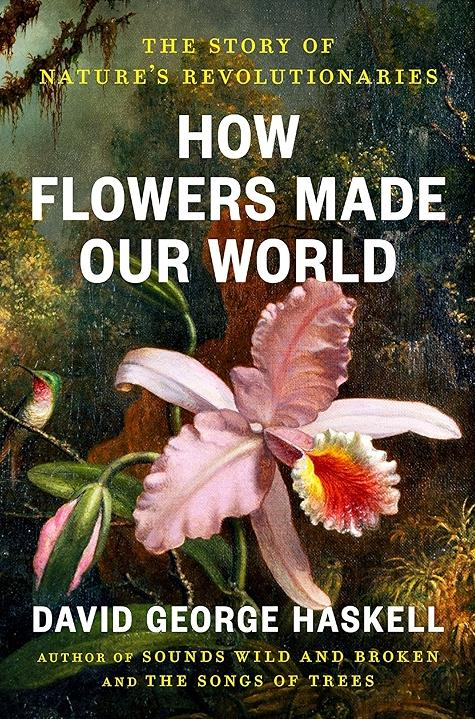
“How Flowers Made our World” is a culmination of thirty years of teaching, research, and writing. Haskell says it is a synthesis of all his past efforts, and that writing it transformed his approach to flowers and flowering plants. He created a video to show off the covers for the US and UK editions.
Haskell’s book is a tapestry rich with threads of floral evolution and ecology, human aesthetics and agriculture, and an understanding of how Earth's diversity and productivity depend on flowering plants. A look at him reading the audiobook's Preface provides a glimpse of Haskell as a speaker.
The content of How Flowers Made Our World includes depth and breadth of information about the plant kingdom. In the chapter titled “Grasses,” he asks the question, “What’s for dinner?” He provides the simple answer, “Grass!” Cereals and bread are made from the seeds of grass. Range-fed beef comes from cattle that eat grass, while feedlot cattle are fattened on corn, a cultivated grass. Haskell stated the importance of grasses as follows:
“If we stacked in 50-kilogram sacks the total cereal harvest in 2023, the pile would reach to the moon 40 times. That’s 2,386 million metric tons of grass flowers turned into seeds. Three grasses – rice, maize, and wheat–account for 90 percent of this superabundance, supplying us with two-thirds of food calories.”
Haskell attributes the success of grass, including their ability to survive in a wide range of envriroments to endosperm, the starchy kernel that fills the husk of grass seeds and dwarfs the embryonic plant. “Grass flowers are supermothers, giving their embryos ample provisions.”
Roses are also quite different from the other flowers discussed in Haskell’s book. Like grains, roses are frequent targets of human interaction and modification. Haskell reveals their importance as symbols of royalty and sources of perfume. Two tons or more of rose petals yield a kilogram of perfume. One of Haskell's videos gives more of the story of roses.
From the human connection to the importance of plants for other species, to the survival tactics of our floral neighbors, Haskell explores the tremendous depth and breadth of plant knowledge. He concludes the book with a supplement of activities the reader can use for hands-on learning about the world of flowers.
“How Flowers Made Our World” is now available for preorder from the publisher and from retailers. A review of Haskell’s previous works appeared in Hellbender Press in 2023.