
Displaying items by tag: climate change
There’s a whole world in the dirt beneath your feet
 The Dust Bowl of the 1930s resulted in the displacement of tons of soil in the midst of a drought similar to the one that grips the Southwest today. Library of Congress
Dirt is far from just dirt. It’s a foundation for life.
This story was originally published by The Revelator.
Look down. You may not see the soil beneath your feet as teeming with life, but it is.
Better scientific tools are helping us understand that dirt isn’t just dirt. Life in the soil includes microbes like bacteria and fungi; invertebrates such as earthworms and nematodes; plant roots; and even mammals like gophers and badgers who spend part of their time below ground.
It’s commonly said that a quarter of all the planet’s biodiversity lives in the soil, but that’s likely a vast understatement. Many species that reside there, particularly microorganisms such as viruses, bacteria, fungi and protists, aren’t yet known to science.
- the revelator
- soil type
- soil moisture
- why is soil important
- drought
- soil microbe
- biodiversity
- soil microorganism
- nutrient cycling
- reading university
- climate change
- soil degradation
- plastic pollution
- genetically modified organism
- pesticide
- artificial fertilizer
- land use change
- compaction
- erosion
- convention on biodiversity
- soil biodiversity observation network
- global soil biodiversity initiative
- ecosystem research
- multidimensionality
- macroecology
- farm to fork strategy
- microbial transplants
- soil quality
- soil sealing
Monarch butterflies, an ephemeral but regular glimpse of beauty, are fluttering toward extinction
 A monarch butterfly, recently declared endangered despite decades of conservation, is seen atop a coneflower. Stephen Lyn Bales
Dramatic monarch declines mean the bell tolls for we
KNOXVILLE — Monarch butterflies are ephemeral by nature. The orange and black dalliances that flitter through our lives, our yards, and our countryside like motes of dust are here one minute and gone the next. We pause for a few seconds to watch the “flutter-bys” and then move on.
For about all of the Lepidopteran family, where they come from, where they go, their raison d'être, we don’t ask. They are winged wisps that pass through our busy lives. But that is not true with this orange and black butterfly, named to honor King William III of England, the Prince of Orange. But two people did ask.
Norah and Fred Urquhart lived in Southern Canada and in the late 1930s they noticed that the monarch butterflies seemed to all be fluttering south this time of the year. Could they possibly be migrating and if so, where did they go? The notion that a butterfly might migrate south for the winter seemed hard to fathom. Yes, broad-winged hawks migrate. But a flimsy butterfly?
- monarch butterfly
- monarch
- are monarchs endangered?
- stephen lyn bales
- stephen bales
- ijams nature center
- lepidoptera
- catalina aguado
- norah and fred urquhart
- flight of the butterflies
- xerces society
- great smoky mountains institute at tremont
- danaus plexippus ssp plexippus
- endangered species
- international union for conservation of nature
- pesticide
- pollinator
- habitat loss
- climate change
- herbicide
- mexico
Dems pass huge climate bill assailed by some as another fossil energy sop

Record-setting bill will fund extensive efforts to address climate change, but the sausage-making deal is decried by some as a ‘suicide pact’
This story was originally published by Tennessee Lookout.
WASHINGTON — The U.S. Senate, along party lines, passed a sweeping energy, health care, climate and tax package Sunday afternoon, following an overnight marathon of votes that resulted in just a handful of notable changes to the legislation.
The 755-page bill was passed after Vice President Kamala Harris broke a 50-50 tie in the evenly divided Senate. It now heads to the House, where Democratic leaders have announced they will take it up on Friday.
At last, we have arrived,” Senate Majority Leader Chuck Schumer said. Democratic senators broke out into applause as Harris announced passage of the bill, expected to total more than $700 billion.
Schumer, a New York Democrat, said he dedicated the measure to young Americans who have pushed and protested for the Senate to take action on climate change.
Congo retreats from climate commitments to fuel its fossil energy sector
NYT: Why should we care when you built your world with fossil fuels?
The government of Congo is recruiting fossil-fuel extractors to suck oil from beneath tropical forest and bog ecosystems that rival the Amazon in their role as carbon sinks.
Opponents say it’s another step in knocking over the dominoes of climate renewal as Russia’s invasion of Ukraine continues to roil energy markets and threaten international commitments to addressing climate change.
Thinking Globally: Many places suffer even worse inflation!

MOTHER EARTH — Scarcity of food, lack of safety nets and paucity of solidarity lead to famine. This explainer by The Economist elucidates much of the detrimental interdependencies of the global economy which resulted in bottlenecks that can not withstand unanticipated shifts in supply and demand.
The South’s hidden climate threat
 Spreading avens are seen in bloom in the Appalachians. The endangered long-stemmed perennials survive in higher mountain elevations but their lack of space to move higher in elevation in times of climate change and warming further threaten the plant. USFWS
It’s not just the coastlines that are recording climate change. Even the mountains of North Carolina are feeling the heat — including some endangered plants
“Atlanta reporter Dan Chapman retraced John Muir’s 1867 trek through the South, including the naturalist’s troubling legacy, to reveal environmental damage and loss that’s been largely overlooked.” This is an excerpt published by The Revelator from his book, A Road Running Southward: Following John Muir’s Journey Through an Endangered Land.
BOONE — It’s a wonder anything survives the ice, snow, and winds that pummel the ridge, let alone the delicate-seeming yellow flowers known as spreading avens.
The lovely, long-stemmed perennials are exceedingly rare, officially listed as endangered, and found only in the intemperate highlands of North Carolina and Tennessee. They sprout from shallow acidic soils underlying craggy rock faces and grassy heath balds. At times blasted with full sun, but mostly shrouded in mist, the avens are survivors, Ice Age throwbacks that refuse to die. Geum radiatum is only known to exist in fourteen places, including hard-to-find alpine redoubts reached via deer trail or brambly bushwhacking.
Hot weather doesn’t always equal evidence of climate change, but the puzzle is almost complete
 Thomas Fraser/Hellbender Press
TVA sets record power day for June as region swelters and common sense degrades
This story was originally published by Hard Knox Wire.
KNOXVILLE — City residents this week joined scores of others around the world — from the Southwest United States to the Indian subcontinent — sweltering through late spring with eyes toward a summer that portends to be very hot.
Whether directly attributed to climate change or not, the heat waves are causing untold misery in locations across the Northern Hemisphere, straining power grids to the brink and causing a sharp rise in heat-related illnesses.
Knoxville Utilities Board asked this week that consumers curtail their electricity use by setting their thermostats a little higher and holding off until night on energy-sucking tasks like doing laundry or running the dishwasher. That request was met in many cases with derision and unsubstantiated claims that charging electric vehicles had overburdened energy infrastructure.
So exactly how hot is it in East Tennessee and how bad is it going to get?
Maybe we should call it Ocean Day
Best Earth Day feature: We still know so little about so much that is vital to life on our planet
CBS News — Stunning midwater creatures of the deep sea
You have to endure a half-minute commercial to see this 6-minute report on the fascinating footage captured by a high-tech marine science project of the Monterey Bay Aquarium.
Make sure to turn on full-screen viewing, if you can. Have you ever seen a bloody belly comb jelly?
We think you’ll agree it’s the most worthwile video you watched today.
Carson-Newman professor hosts installment of worldwide “Climate Teach-in”
 Carson-Newman University Professor Brian Sohn is hosting a climate-oriented webinar on March 30. Thomas Fraser/Hellbender Press
Local installment of worldwide virtual Climate Teach-In is set for 2:30 p.m. March 30
JEFFERSON CITY — Brian Sohn had “the closest thing to a panic attack” when his second daughter was born.
He had long been alarmed by climate change and its potentially disastrous effects, but her arrival brought home the need to address the environmental challenges of a rapidly changing planet.
So now the Carson-Newman University education professor is putting some final touches on a virtual climate-related “teach-in” he’ll host from 2:30 to 3:30 p.m. Wednesday, March 30.
New year. Old challenges.

From plastic pollution to extreme weather and the extinction crisis, the year ahead promises tough fights, enormous challenges and critical opportunities
This story was originally published by The Revelator.
A new year brings with it new opportunities — and more of the same environmental threats from the previous 12 months.
You’ve got the whole world in your hands

Personal climate-change remedies have a wide cumulative impact and are part of the solution, so don’t give up
Tom Ptak is assistant professor of Geography and Environmental Studies at Texas State University. This story was originally published by The Conversation.
The average American’s everyday interactions with energy sources are limited. They range from turning appliances on or off, to commuting, to paying utility bills.
The connections between those acts and rising global temperatures may seem distant.
However, individuals hold many keys to unlocking solutions to climate change — the biggest challenge our species currently faces — which is perhaps why the fossil fuel industry spent decades misleading and misinforming the public about it.
I’m an assistant professor of geography and environmental studies at Texas State University. My research explores how geography affects the complex relationships between societies, energy and contemporary environmental challenges. I’ve found that the human element is critical for developing creative, effective and sustainable solutions to climate challenges.
There’s a large and growing body of evidence showing that individuals can have a major impact on climate change in a number of ways. Citizen action can compel utilities to increase renewable energy and governments to enact strong climate action laws. When enough individuals make changes that lower daily household energy consumption, huge emissions reductions can result. Consumer demand can compel businesses to pursue climate and environmental sustainability.
These actions combined could bridge the “emissions gap”: the significant difference between the greenhouse gas emissions expected globally and how much they need to drop in the next few decades to avoid catastrophic climate change.
- climate change
- individual action
- personal responsibility
- energy consumption
- energy conservation
- geoengineering
- consumer choice
- consumer demand
- citizen action
- citizen participation
- public participation
- climate leadership
- emission reduction
- collective action
- carbon emission
- renewable energy
- energy efficiency
- fuel consumption
- weatherization
- energy use
Get involved: Protestors lock arms to demand TVA swear off fossil fuels for good
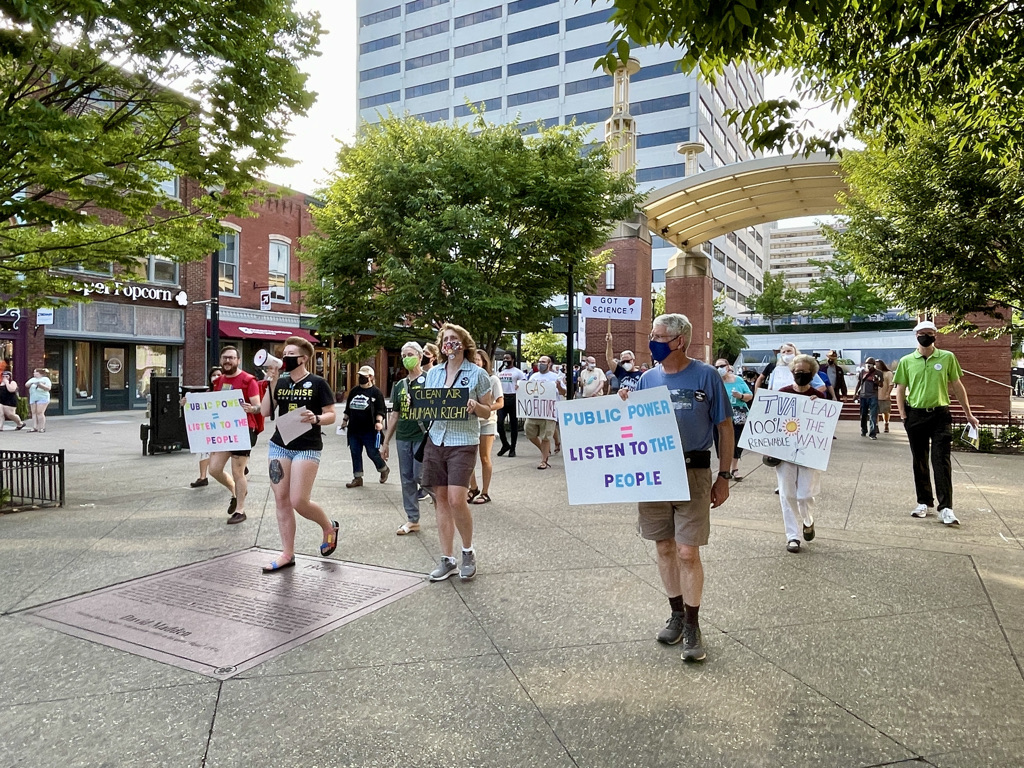 Protestors chant and wave signs urging TVA to commit to a fossil fuel-free future during a protest in downtown Knoxville this summer. Courtesy Amy Rawe/Southern Alliance for Clean Energy
Activists will demand TVA allow public comments during a protest planned for Wednesday morning outside TVA HQ in downtown Knoxville
Knoxville clean-air activists plan another protest Wednesday outside of Tennessee Valley Authority headquarters to demand a return to public-comment periods and a commitment the huge utility won’t rely on fossil-fuel energy sources in the future.
“Public input is critical right now, while TVA is considering building new, large fossil gas power plants and pipelines, even though they would be contrary to our need to cut greenhouse gas emissions in half by 2030,” said protest organizer Brady Watson of Southern Alliance for Clean Energy. Statewide Organizing for Community Empowerment is also coordinating the protest.
University of Tennessee climate panel: Scientists say don’t despair. Yet.

Scientists discuss climate challenges and solutions during 2021 One Health Day
As climate experts and scientists huddled in Glasgow in an international effort to stem potentially disastrous global environmental changes, a panel of doctors representing multiple disciplines at the University of Tennessee and beyond offered their assessments of climate challenges and solutions.
Their take on climate change? We have problems, but we also have solutions. Hopelessness will drive you crazy. Stay healthy, stay informed and do your part to mitigate the long-term environmental consequences of a changing Earth.
Above all: Don’t despair and don’t lose hope.
The panel, held Nov. 3 at the UT Student Union and presented by the UT One Health Initiative, consisted of the following experts:
— Dr. Gus Engman, Department of Forestry, Wildlife, and Fisheries, University of Tennessee Institute of Agriculture
— Dr. Kate Evans, Computational Sciences and Engineering Division, Oak Ridge National Laboratory
— Dr. Joshua Fu, Department of Civil and Environmental Engineering, University of Tennesse
— Dr. Sindhu Jagadamma, Biosystems Engineering and Soil Science, University of Tennessee Institute of Agriculture
— Dr. Kristina Kintziger, Department of Public Health, University of Tennessee
Answers have been edited for clarity and brevity and don’t include the full response. Questions were submitted ahead of time or during the panel discussion.
What do you see as the largest threats of climate change, especially related to your individual research interests?
Engman: Changing precipitation patterns are something I think about a lot.
Pretty much all the rivers in the world are expected to have changes to their flow regime.
These changes in droughts and floods are a really large issue.
I think a lot about aquatic communities. If we are scarce on drinking water, we are always going to prioritize people having that water, over the fish or the bugs in the streams.
There are all kinds of impacts to life histories and interactions with communities in streams.
When animals are stressed because of these changes in precipitation patterns and changes in flow patterns, they might become more susceptible to other stressors, like disease.
Changes in algal community composition can impact the entire water quality of a stream, and that might happen because of these changes in precipitation patterns.
These places that are experiencing these extreme droughts really worry me. The Colorado River already doesn’t even flow all the way to the ocean anymore. That’s a huge change. Because we take up so much water for agriculture.
If a stream runs out of water, it’s not a stream anymore.
Evans: From a meteorological perspective, the biggest event that hurts people's health is actually heat waves. A lot of press goes to tornadoes and hurricanes and storms but in fact these large domes of hot air (are deadly), which happen because of changes in the large-scale weather patterns.
The greenhouse effect insulates the earth, it makes it more uniform in temperature and so that changes the flow patterns that go around the earth. That changes those big weather systems that come in and how long they stick around.
When you talk about these long droughts, we know that’s what's we have to understand: Will they last longer, be more humid, less humid, and that has huge impacts for human health as well as the food they eat and the plants that grow.
Kintziger: Heat also has a bigger impact on a more indirect pathway to human health. Not just heat-related illness but also cardiovascular impacts, renal impacts and even mental health impacts.
Heat is the one that keeps me up at night. We are seeing increasing temperatures globally and we also have this urban heat island affect.
Our vulnerable populations in the cities — inner cities with lower-income housing, homeless populations — they are going to experience heat very differently than people who live in newer buildings with better cooling and infrastructure and have better capabilities for adapting to heat.
(Remember this?) Report: Sen. Joe Manchin, a holdout Democrat on climate-change legislation, is a “coal baron”

The Guardian: Manchin monkey-wrenches climate change legislation because he’s made millions off fossil fuels
West Virginia Sen. Joe Manchin, the Democratic linchpin for game-changing climate legislation proposed in a budget bill as part of the Biden administration’s plan to provide aid to families as well as give a boost to efforts to reduce global warming, has thrown a now-infamous wrench in the works.
He has vigorously opposed key parts of the climate legislation included in the 2022 budget bill. Per the Guardian, it’s simply because he and his family have made a fortune off coal extraction in the relatively impoverished state of West Virginia and elsewhere.
“Financial records detailed by reporter Alex Kotch for the Center for Media and Democracy and published in the Guardian show that Manchin makes roughly half a million dollars a year in dividends from millions of dollars of coal company stock he owns. The stock is held in Enersystems, Inc, a company Manchin started in 1988 and later gave to his son, Joseph, to run,” according to the Guardian.
“He has already effectively succeeded in stripping the bill of its most powerful climate change provision, a program that would have rapidly shut down coal and gas-fired power plants and replaced them with wind and solar power,” according to the New York Times.
From the Gulf Coast to the most densely populated American corridor, Ida laid bare our flimsy climate-change preps
Hurricane Ida hit the Gulf Coast with flooding rains, catastrophic winds, storm surge and the highest wind gust (170 mph) ever recorded in the United States.
The hurricane devastated Louisiana barrier islands and left at least 10 people dead and millions without electricity before it peeled off for a destructive jaunt up through the Mid-Atlantic region, where it joined with a slow-moving Northeastern warm front for what was truly the perfect storm.
Many forecasters, once again, said that climate change was largely responsible for the devastation that spanned the good part of a nation.
Record rain amounts were registered at both Central Park and Newark (New Jersey) airport.
Climate change brings historic rains and ruin to Southern Appalachians and Middle Tennessee

Washington Post: Devastating Middle Tennessee floods latest consequence of climate change
Training thunderstorms dumped 17 inches of rain within 24 hours last week in Middle Tennessee, causing a cascade of runoff that led to localized flash flooding of creeks and rivers that killed at least 20 people and destroyed the small town of Waverly. That amount of rain, which a climatologist said had a 1 in 1,000 chance of occurring, would set a record for the highest amount of daily rainfall recorded in the entire state.
A lesser-noted flood of the Pigeon River just over the state line in Haywood County, North Carolina a week ago killed at least five people and destroyed homes and property as the remnants of Tropical Storm Fred moved over the region. The towns of Canton and Clyde were particularly hard hit. A rain gauge in Cruso recorded nearly 15 inches of rain in less than three days, according to the Smoky Mountain News. Nine inches fell within a 24-hour period.
Deadly floods in Germany and the European lowcountry this summer that killed 200 people were also attributed to climate change.
A warmer atmosphere holds exponentially more moisture, so such intense rainstorms will increase in coming years as climate change reshapes the Earth, scientists told the Washington Post.
"It’s yet another example of how climate change has loaded the dice for disaster, experts say. The floods that people lived through in the past are no match for the events that are happening today. And what in 2021 seems like an unprecedented catastrophe may by 2050 become an annual occurrence," the Post reported.
The flooding threat promised by a warming planet is exacerbated by continuing urbanization and inadequate public stormwater infrastructure. More impermeable surfaces means more runoff.
Raise your voice for clean energy today in downtown Knoxville
Looking for something to do after work? Want to be part of a rising movement urging TVA to move away from fossil fuels in the face of the global climate crisis? Support transparency from the largest public utility in the country?
The Southern Alliance for Clean Energy, Appalachian Voices, Center for Biological Diversity, the Sunrise Movement, Sierra Club, and other local organizations are hosting a clean-energy rally from 6 p.m. to 7:30 p.m. today (Aug. 18) on Market Square near TVA’s headquarters in downtown Knoxville.
TVA hasn’t had a public listening session in over a year, according to rally organizers. Rally participants will demand that TVA:
— Restore public listening and input sessions;
— Commit to 100 percent clean energy by 2030;
— Not build new fossil gas plants;
— Protect coal ash workers, and;
— Dispose of coal ash properly with public health and safety as the utmost priority.
The rally will feature songs from local musicians, a reading of demands for TVA, speakers discussing pressing issues for TVA and our region, and a short march around Market Square.
Masks and social distancing are encouraged. For those unable to attend in person, a virtual option is available at Tennessee Valley Energy Democracy Movement Facebook page.
United Nations climate report: We are in dire straits and it’s getting too late
Washington Post: Carbon dioxide levels at highest point in 2 million years
A United Nations climate report authored by 34 people mining 14,000 scientific studies concludes that substantial climate change and its effects are now largely unavoidable but nations, municipalities and individuals can still take steps to minimize the consequences as much as possible.
Here are some key points from the Intergovernmental Panel on Climate Change report:
— Human-caused global climate change is an irrefutable fact. Now the debate is what we do about it.
— Few if any signatories to the 2015 Paris Climate Accord met their pledged reduction targets.
— At current emissions rates, the Earth will have heated to or beyond 2.7 degrees (F) above pre-industrial levels by the 2030s.
— Hurricanes, cyclones, droughts, heat waves and other weather anomalies will worsen.
The report comes as many present disasters linked to global warming unfold around the world. The second-largest wildfire in California history burned in the drought-stricken state; Greece dealt with historic wildfires; and Germany and the European Lowcountry reeled from an unprecedented rainstorm that destroyed entire towns and killed more than 200 people. Another heat wave is supposed to arrive in the Pacific Northwest this week.
FGS calls on TVA to get serious about addressing the climate crisis
As Hellbender Press reported in April, the Tennessee Valley Authority plans to phase out its use of coal. And as we mentioned in an action alert, TVA is conducting a scoping process pertaining to the preparation of an Environmental Impact Statement (EIS) for retirement and replacement of the Kingston Fossil Plant. TVA is preparing similar EIS for its other remaining coal-fired power plants as well.
Although TVA lists "construction and operation of solar and storage facilities" in these scoping documents as an alternative for replacement of coal as the power source, it has made no secret of its belief that construction of gas-powered combustion turbines (CT) and natural gas pipelines to feed them will be the best solution to replace the outdated generation capacity.
Unlike other power utilities, TVA has been making it more difficult, financially unattractive or impossible for distributed renewable energy, storage and even efficiency projects to get realized, according to proponents of renewables and some of TVA’s local power distribution partners. TVA also reneged on its agreement with other utilities to make large amounts of wind power available to the Southeastern United States through the Plains & Eastern Clean Line high-voltage direct-current power line project.
- tennessee valley authority
- tva
- foundation for global sustainability
- fgs
- climate change
- climate crisis
- electric utility
- power plant replacement
- fossil fuel
- coalfired power plant
- gasfired power plant
- gas pipeline
- kingston fossil plant retirement
- distributed electricity generation and storage
- distributed energy resource
- solar energy
- power storage
- stranded asset
- germany
- renewable energy
- decarbonization
- plains & eastern clean line
Scientists and engineers will examine potential role that rising sea levels contributed to Florida condo collapse
Washington Post: Sea level rise will be investigated as one possible factor in Florida condo collapse
There is no direct evidence yet that increased subsidence on a Florida barrier island caused by rising sea levels and saltwater intrusion contributed to the devastating collapse of an ocean-front condo complex near Miami, but the possibility will be examined in coming weeks and months.
Rising sea levels threaten seaside properties on an increasing scale, undermining the unstable land on which they sit and further contributing to erosion of steel and concrete.
In the case of Champlain Towers South, developers used fill from denuded mangrove stands to support the 12-story building, which was built in 1981.
“Land subsidence is a gradual settling or sudden sinking of the surface when material that supports it is displaced or removed, according to the U.S. Geological Survey. Erosion and the disappearance of groundwater are two of several factors that cause it,” the Washington Post reported.
A least one engineer has said the collapse could be related to a structural problem, not subsidence. The investigation continues, as does the search for bodies.